
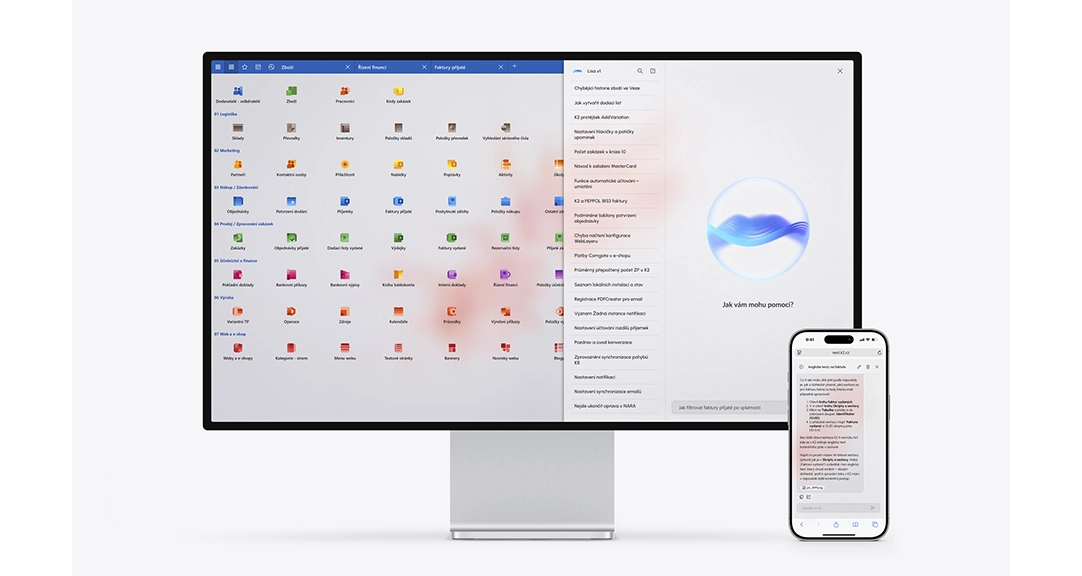
How AI is turning K2 into a smarter ERP system
11.11.2026
6 min reading
When you talk to K2 Head of Development Tomáš Szkandera, his excitement about how far the use of artificial intelligence in K2 has come is evident in every sentence. “This is a genuine revolution in enterprise systems,” he says enthusiastically. Artificial intelligence has become one of the fundamental building blocks for the future development of K2.
AI is changing the way companies work with their data
One of the most significant developments is K2 Lisa, the virtual assistant that was already available in the previous version of K2. At that stage, however, it worked with a limited range of data. “We taught Lisa the entire K2 documentation as well as the content of our recorded webinars. This made it easier for users to find answers without searching through help documentation or calling our hotline,” explains Tomáš Szkandera.
In the new version, Lisa can work with data from across the entire system. This enables her to perform analyses using virtually any data available in K2. “It works in the way users have become accustomed to with the most popular and widely used language models. You can have a natural conversation with Lisa and ask her anything you want to know about the system. Within seconds, she can answer a manager’s question such as: Which store generated the highest revenue or margin yesterday? At the same time, she automatically suggests follow-up questions and more advanced business analyses,” adds Szkandera, who has led the K2 Group’s development team in recent years.
Power BI in seconds
“Even today, we provide owners and decision-makers with an extraordinary amount of data, giving them a comprehensive view of inventory, production, orders, financial indicators and accounting operations. We also work with standard dashboards created in Power BI. In the new version, however, everyone can access information in an entirely new way. All you have to do is type – or even simply ask by voice – what you want to know. Within seconds, you receive clearly presented information, complete with useful context and suggestions for potential next steps. It is like having Power BI available within seconds, empowering managers to become much better decision-makers. You no longer need an in-depth understanding of the system itself. You simply need to ask the right question and then use the data to make your next decision,” says Petr Schaffartzik, Chairman of the Board of the K2 Group.
Keeping company data completely secure
Unlike publicly available language models, an enterprise system must, of course, comply with the strictest security requirements. “No sensitive data leaves the system when artificial intelligence is used. We have developed everything ourselves, and all analyses are performed exclusively using internal company data already processed by K2 software. Access is governed by precisely defined user roles and permissions, just as it is today. We see security as requirement number zero – it is something we take into account automatically. If something is not fully secure, it simply does not move on to the next stage of development,” explains Tomáš Szkandera.
How does K2 ERP use AI?
- A virtual assistant built directly into the system. K2 Lisa knows the entire K2 documentation as well as recordings of all our webinars. She can advise users on how to perform specific tasks in the system. Instead of searching through help documentation or calling the hotline, users can simply ask a question in natural language.
- Smart suggestions. AI Data Suggestion means that all you need to do is click in a search field and K2 will suggest the most likely value based on historical data and context. One click and the field is complete – faster and with fewer errors.
- Semantic search in e-shop. The search engine understands the intent behind a query rather than relying solely on keywords. Customers can describe what they need in natural language and receive relevant product results.
What else can AI do in K2?
- Making the system easier for everyone to understand. In many areas, there is less need for complex system training. Thanks to real-time conversations, users can simply formulate a question and receive an answer within seconds.
- Lisa works in a similar way to popular AI tools. K2 Lisa responds quickly to questions about company data. You can use her to analyse data in real time or ask natural-language questions about key areas of your company’s processes.
- Power BI in real time. Using simple, naturally phrased questions, you can work with the results and perform advanced business analyses in real time.
- Voice control. If you do not want to type your questions, you can simply ask them using your voice.