
Companies get 60% of the way with AI. We know how to finish their projects
30.10.2026
5 min reading
Blaze, a company based on Generála Sochora Street in Ostrava-Poruba, is different in many ways from the businesses we are used to seeing. After all, when Jan Netolička founded the company at the age of twenty, he was still coming up with its name and logo at the notary's office. Yet in just five years, thanks to its all-in commitment to artificial intelligence, Blaze has grown to achieve a turnover of more than CZK 10 million, works for billion-crown corporations – and most recently, the K2 Group acquired a 51% stake in the company.
How can such a partnership work in practice? On one side, a traditional developer of enterprise systems for medium-sized and large companies, employing more than 300 people. On the other, an agile team of students and recent graduates who meditate together at work and spend their free time training for Ironman triathlons and HYROX fitness competitions? With completely different corporate cultures and approaches to life? At Blaze, AI is involved in virtually everything – Jan Netolička himself constantly tracks and evaluates his sleep, adjusts his diet based on recommendations from language models, and applies a longevity-focused approach not only to himself but also to his colleagues...
We will have to wait a little longer for the answer – but both sides are convinced that this is a perfect match. K2 gains drive, out-of-the-box thinking and a team of enthusiastic AI-first developers, while Blaze gains access to top-tier IT infrastructure and hundreds of major clients, the vast majority of whom know they should be using artificial intelligence to transform their processes.
Yet these companies often struggle to see their projects through, leaving them stuck in limbo. This is precisely where Blaze's greatest strength lies – they get things done, measure returns on investment and know how to move projects into the MVP stage. In other words, they can quickly test a product on the market.
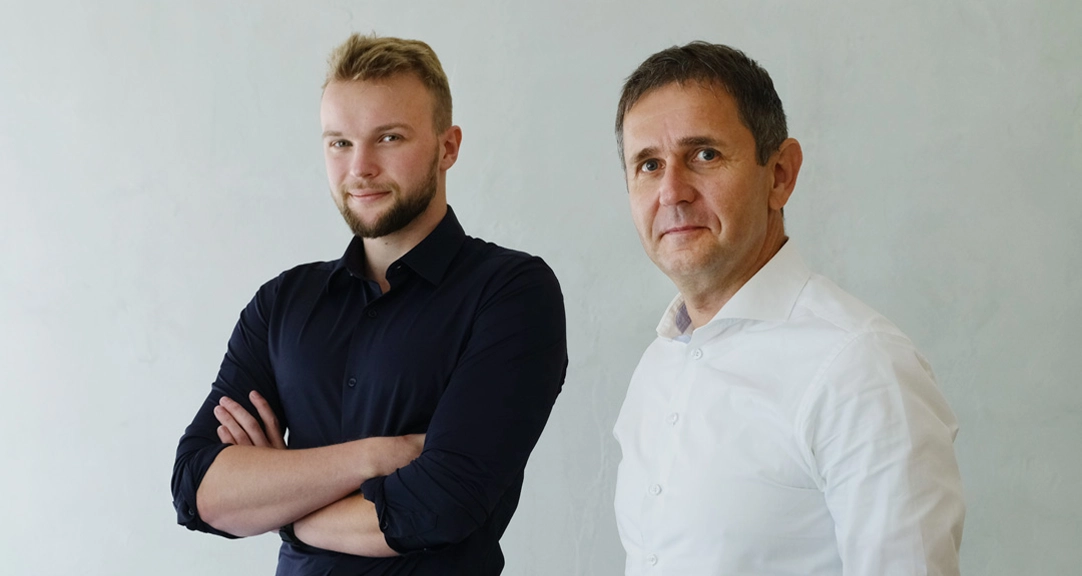
We discussed the details not only with 25-year-old Jan Netolička, but also with investor Dobroslav Vlček, who is a generation older and joined the company some time ago. "I told Blaze that before investing, I wanted to observe them for a while," says Dobroslav Vlček. "But he meant a year – and we meant weeks," Jan Netolička laughs. Could there be a better illustration of how quickly times are changing and just how extraordinary the pace of everything related to AI has become?
How did Blaze make the transition from startups to major corporate projects?
Jan Netolička: We started five years ago, with the arrival of the first GPT models. We grew up in the world of software startups and developed dozens of applications – from unconventional projects and MVP development (aimed at quickly and cost-effectively verifying whether there is any market demand for a product and gathering feedback before spending money on full-scale development) to commercially successful solutions.
We worked with very tight budgets and minimal resources, which became one of our greatest strengths. We learned to deliver solutions quickly and efficiently, without spending hundreds of thousands on unnecessary project management or complex analyses.
But the market is changing. We used to build startup projects with budgets running into millions of crowns. Over time, however, people have learned some of our skills, either from us or through their own exploration of AI. As a result, demand for this type of work has declined, and we have naturally moved in the same direction as the wider market – towards large companies, manufacturing giants and corporations that need real efficiency rather than theoretical discussions.
How do you assess the readiness of executives and owners of large companies for AI?
Dobroslav Vlček: Everyone knows they have to act. When we visit dozens of companies, we see much the same thing everywhere: everyone is talking about AI and digitalisation. The CEO acts as though everything is under control, but if they have been running the company for 10 or 15 years, they are already operating at 120% of their capacity.
AI is such a vast field that they have no realistic chance of understanding it in depth on their own. They often leave it to their IT department. But what does a typical corporate IT department look like? It is run by a fifty-year-old guy who installed the network years ago, connected the first server and has been looking after the on-premise infrastructure ever since.
Large companies are understandably nervous because they see trillions being poured into AI and do not want to put their business at risk. Their response is often: "Here are 100 Claude licences. Let's start coding."
Three months later, they are tearing their hair out because instead of producing one useful output, the marketing department is generating fifty thousand unnecessary texts, burning through tokens, driving up costs and creating even more work.
So what is the right approach?
Dobroslav Vlček: Companies need a partner who genuinely understands the technology and knows how to implement artificial intelligence in a way that actually makes people's lives easier.
And there is one thing that needs to be made clear from the outset: this is not a one-off project. You cannot simply bring in a supplier, have everything finished in six months and then forget about it for the next five years.
You will need what we call an AI lab – someone who constantly stays up to date, lives and breathes AI 24/7, builds a "second brain" and continuously works on improving it.
It is much the same as working with CRM or ERP systems. And we are fortunate that our partnership with K2 allows us to fully embrace this wave and offer companies the confidence and stability they need.
How does your partnership with K2 and the recent acquisition fit into this?
Jan Netolička: Joining forces with K2 is a huge shortcut for us. K2 has a strong foundation, credibility and an extensive customer base of Czech companies dealing with complex business operations – manufacturing, logistics and supply chains.
On the other hand, K2 grew through selling development hours and traditional enterprise systems, whereas we bring drive, speed and deep expertise in developing AI agents.
Dobroslav Vlček: The market today is full of people who call themselves "vibe coders", but they often lack a deeper understanding of business processes and direct experience with real companies.
We, on the other hand, combine startup drive with corporate stability. We do not want to create "AI chaos", where everyone experiments independently without any coordination.
Our solutions are structured, well organised and focused on a clearly measurable return on investment (ROI).