How Paketo group doubled production capacity with K2 without adding a single machine or employee
12.10.2026
8 min reading
Can industrial manufacturing be managed entirely from memory? If you do not plan to grow, then perhaps for a while. However, that was not the case for Paketo group from Vsetín (the Paketo.one business division and custom manufacturing brand Paketo.cz). Originally a high-volume supplier of corrugated cardboard packaging, the company had to respond to a changing market that increasingly demanded smaller production runs, personalized packaging, and custom-designed solutions.
The transition to digital custom manufacturing brought satisfied customers, but it also introduced internal complexity. The key to both the technological and business transformation was the implementation of advanced production planning within the K2 ERP system.
From high-volume production to digital flexibility
Customers gradually moved away from standardized high-volume orders and began demanding personalized solutions—smaller production runs, specialized materials, unique designs, and custom development services. Paketo responded by launching a specialized packaging materials e-commerce store and continuously investing in its own production technologies.
Unlike competitors that focused on highly productive but inflexible production lines, Paketo strategically invested in fully digital manufacturing. As a result, the company can produce an order of 50 units with the same efficiency and quality as a production run of several thousand pieces.
Its technological infrastructure now includes:
- Digital gluing machines: capable of automatic setup for different product shapes and complexity levels without being tied to a single production line.
- Automated plotter systems: operating 24/7, requiring operators only to load and unload materials while programming the machine with just a few clicks.
- Fully digital large-format printers: eliminating color limitations and enabling the production of anything from small gift boxes to giant printed packaging for the automotive industry.
- High-capacity production equipment: serving customers who have grown alongside the company and now require large production volumes.
When “planning in your head” is no longer enough
As custom manufacturing expanded, Paketo group’s portfolio evolved into three primary business segments driven directly by market demand:
- Packaging: ranging from standard brown shipping boxes to premium executive gift sets.
- POS/POP Displays: complex retail display solutions with various shelves, dimensions, and components, delivered either assembled or flat-packed.
- Industrial Protective Packaging: a rapidly growing segment driven by the European PPWR regulation. Paketo effectively replaces polystyrene and plastics with environmentally friendly cardboard solutions, even for highly valuable and sensitive products shipped worldwide. Its engineers work directly at customer sites to simulate and optimize packaging processes without slowing down logistics operations.
When the company operated one or two machines, production could still be managed manually. Once the number of critical production resources grew to six or more, planning became virtually impossible. What remained was merely tracking deadlines without any real feedback from the shop floor. Management lacked visibility into whether orders were progressing on time, how much scrap was being generated, or whether materials were being consumed correctly.
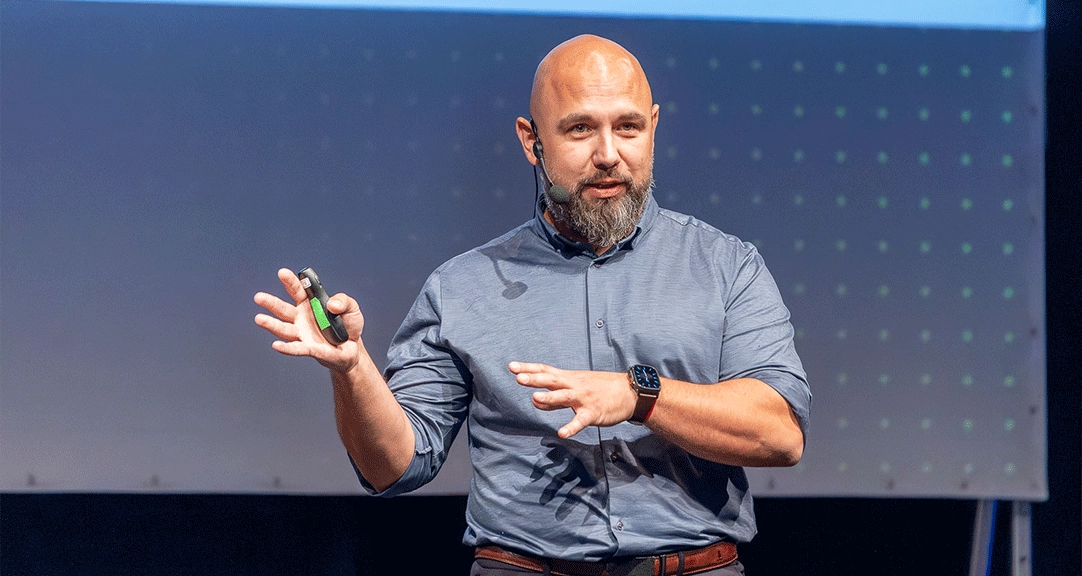
“The entire operation depended on the memory of a single person—the production manager. If he planned a vacation, the entire company spent two weeks hoping the system would continue functioning through momentum alone. The real problem emerged when unexpected illness occurred. Training a new manager in such an environment would take at least two months, and there was always a risk they would create their own uncontrolled processes. This situation generated internal quality issues, logistical bottlenecks, and financial losses,” says Palo Lezo, CEO of Paketo group.
K2 didn’t have the best visual design, but it had the best system
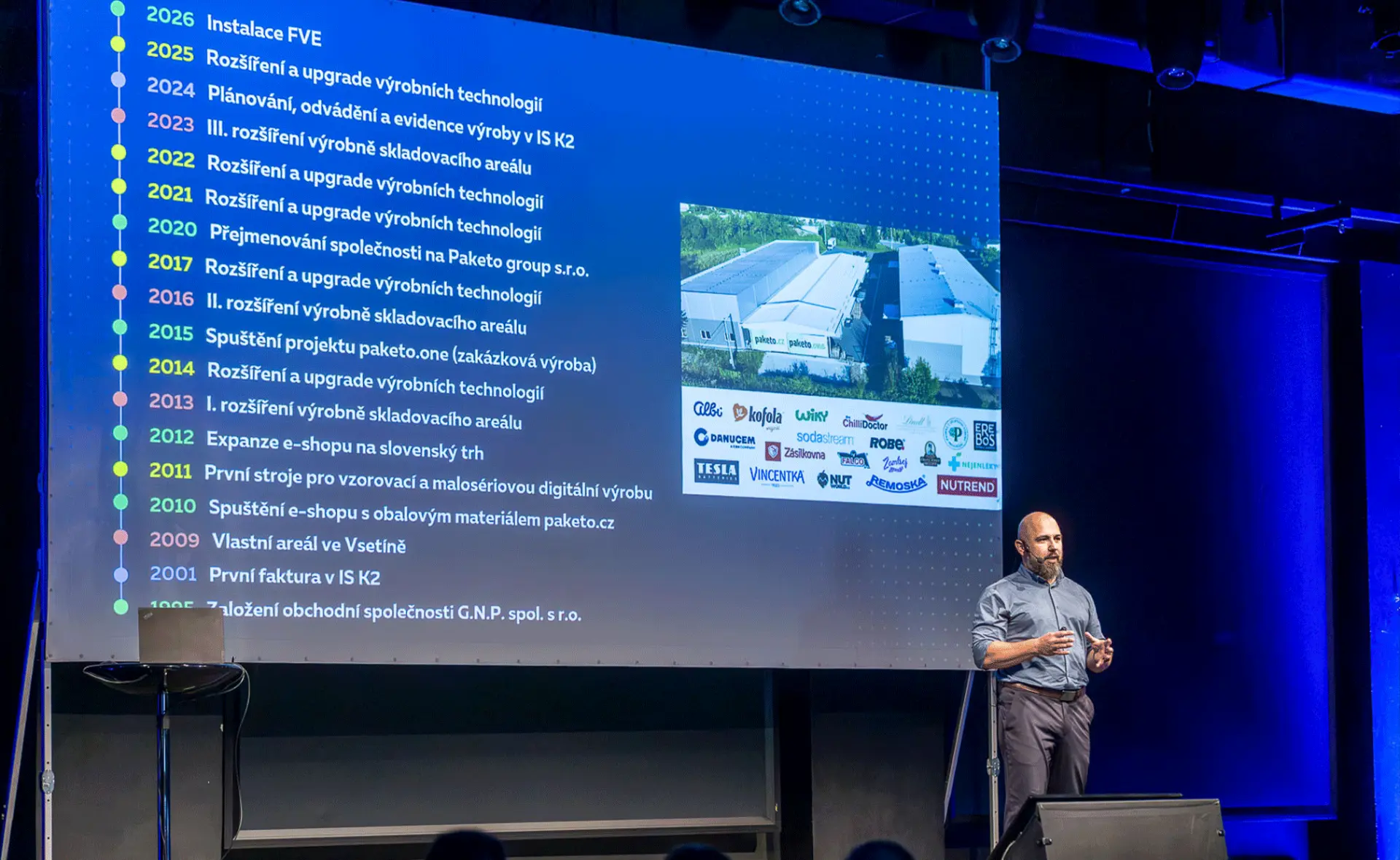
Paketo had been using the K2 ERP system since 2001. When production challenges became unsustainable in 2024, management began searching for a specialized advanced production planning solution.
“Some competing systems offered more attractive visual interfaces at first glance. However, comprehensive integration ultimately became the deciding factor. Connecting an external planning solution with our existing warehouse management, invoicing, and production feedback processes would have been both technically and financially extremely complicated,” recalls Palo Lezo.
Representatives from Paketo group therefore attended an intensive one-day workshop at K2 headquarters in Ostrava. The result of this technological “ping-pong match”—where spreadsheet-based thinking was challenged by the logic of a robust ERP platform—was a decision to fully implement the K2 Production Planning module.The company chose to understand the system’s standard processes, adapt its internal operations accordingly, and transfer critical know-how from employees’ minds directly into software-driven workflows. K2 became the central intelligence that autonomously determines the optimal sequence of tasks and production operations.
Key benefits of the implementation
The introduction of automated production planning in K2 delivered immediate and measurable results across the entire organization.
1. Complete control over pricing and margins
Because operators report their work directly into K2 in real time, management gains immediate visibility into material consumption and machine utilization. The system automatically calculates actual production costs. Sales representatives can compare original quotations with real manufacturing costs directly within each order, making it immediately clear whether a problem originated in pricing or in production inefficiencies. As a result, production operations stopped generating hidden losses.
2. Elimination of production bottlenecks and better order coordination
K2 efficiently combines and sequences dozens of different orders—from small production runs to large-scale projects. Machine operators no longer need to decide what should be produced next; they simply process the tasks assigned to them by the system. K2 also ensures that all semi-finished products and components arrive at final assembly at exactly the right time. This eliminated situations where multiple jobs competed for the same production resource simultaneously, creating operational bottlenecks.
3. Immediate feedback and a 90% reduction in complaints
Information flows in both directions. Operators can record comments and issues directly while reporting their work. Conversely, whenever an error or internal complaint occurs, management immediately transfers that information into production engineering and preparation processes. When a new production order is printed, operators see the warning immediately. This approach reduced both internal and external complaints by nearly 90 percent. Simply put, the same mistakes are no longer repeated.
4. Inventory optimization and improved cash flow
As soon as production is scheduled, the required materials are automatically reserved and allocated from inventory. The purchasing department knows exactly how long current stock levels will last and what needs to be ordered. This enabled the company to significantly reduce inventory levels, increase inventory turnover, and free up substantial financial resources that had previously been tied up in excess stock.
5. Workforce planning and adaptation to legislative changes
K2’s visual planning dashboards allow management to see workforce utilization up to a week in advance. This enabled Paketo to respond effectively to stricter regulations regarding temporary workers. While many competing companies reduced their use of temporary labor due to increased administrative complexity, Paketo knew precisely when additional personnel would be needed and where existing employees could be reassigned.
6. Exceptional flexibility during operational changes
When customers request accelerated delivery dates or material shortages occur, planners simply enter the changes into K2 and allow the system to recalculate. Within seconds, the software completely reschedules production while taking all process dependencies into account. Production can be rescheduled multiple times per day without the risk of human oversight.
Implementation results
The best proof of the system’s effectiveness was its measurable impact. Production planning in K2 went live in spring 2024 and reached full deployment during the summer of the same year.
Comparing the full years 2023 and 2024, while maintaining the same number of employees and production equipment, Paketo achieved a 35% increase in revenue. The growth could have been even higher if sales activities had been expanded more aggressively, as production suddenly had available capacity.
The real breakthrough came during the summer months. July and August are traditionally challenging periods in the packaging industry due to vacations and the reliance on temporary workers who are not fully familiar with all processes. Nevertheless, in July 2024 the company generated more than double the revenue achieved in July 2022 and July 2023.
Production supervisors themselves described operations as significantly smoother and less demanding than in previous years. Initially, they considered it impossible that the company had produced twice as many products. The system removed a tremendous administrative and mental burden by managing workflow coordination automatically.
The only unexpected side effect was that the increased transparency exposed additional bottlenecks in logistics and infrastructure. As a result, Paketo invested twice its originally planned budget into facility development during 2024 and 2025.
The future: scalability and web-based K2
The Paketo implementation demonstrates the exceptional scalability of the K2 ERP system. The company started with a modest setup—a single reporting terminal and paper-based production documentation. Even this minimal foundation generated benefits worth millions.
Today, Paketo is preparing to transition to the new web-based K2 platform. Management is focused on gaining real-time production visibility directly from mobile devices. The next phase will eliminate paper documentation entirely and introduce K2 touchscreen terminals at every machine and workstation, providing even more detailed production feedback.
The implementation of production planning in K2 proved that a properly deployed ERP system is not an administrative burden but a transparent tool that helps employees perform better.
When the system takes over routine planning and control activities, people gain more time and freedom to focus on creativity, strategic initiatives, and business growth.